
Mugapakkha Jataka
Mugapakkha Jataka
In the ancient land of Mithila, there lived a king named Janaka, a ruler of great wisdom and righteousness. Yet, even the wisest of kings can sometimes be tested by the shadows of doubt. King Janaka, despite his virtue, found himself increasingly troubled by whispers and doubts concerning the purity of his intentions. He feared that his good deeds might be tainted by hidden desires or a subtle craving for recognition, a thought that gnawed at his conscience.
To seek clarity and to understand the true nature of selfless giving, King Janaka embarked on a spiritual journey. He decided to wander through the land, disguised as a humble mendicant, observing the world and the people from a different perspective. He left his palace, entrusting the kingdom to his capable ministers, and set out with nothing but his robes and a begging bowl.
His travels led him to a dense forest, where he encountered a peculiar sight: a young man with an unusually large and round head, sitting in deep meditation. This young man was none other than Bodhisattva, in a past life, who had taken a vow to achieve enlightenment through extreme asceticism, even to the point of self-mortification, if necessary, to conquer attachment to the physical form. He had vowed to remain silent, to speak only when absolutely necessary, and to endure all hardships without complaint. His countenance was serene, his body emaciated from rigorous fasting, but his eyes held a profound peace.
King Janaka, intrigued by the ascetic's unusual appearance and unwavering resolve, approached him with respect. "Venerable sir," he began, his voice filled with genuine curiosity, "your devotion is remarkable. But tell me, what is the purpose of such extreme austerity? What do you hope to achieve by enduring such hardship in silence?"
Bodhisattva, who had taken a vow of silence, did not reply verbally. Instead, he slowly raised his hand and pointed towards the sky, then towards his own head, and then made a gesture of giving away. King Janaka, a man of deep insight, pondered this gesture. He understood that Bodhisattva was indicating that his efforts were directed towards transcending the physical self, the head, and that the ultimate goal was a state beyond worldly attachments, a state of liberation to be attained through profound self-discipline.
The King, still grappling with his own doubts, continued to observe Bodhisattva. He saw the ascetic endure scorching sun, biting winds, and drenching rains, all without a flinch. He witnessed Bodhisattva subsist on meager offerings, sometimes nothing at all, yet his inner peace remained undisturbed. The King himself, in his guise as a mendicant, had to beg for his own food, experiencing firsthand the pangs of hunger and the humility of asking for alms. This shared experience further deepened his empathy and understanding.
Days turned into weeks, and King Janaka remained by Bodhisattva's side, a silent observer. He saw how Bodhisattva’s unwavering focus and detachment from bodily discomfort were gradually leading him towards a state of profound inner stillness. The King’s own anxieties began to dissipate, replaced by a growing admiration and a sense of awe.
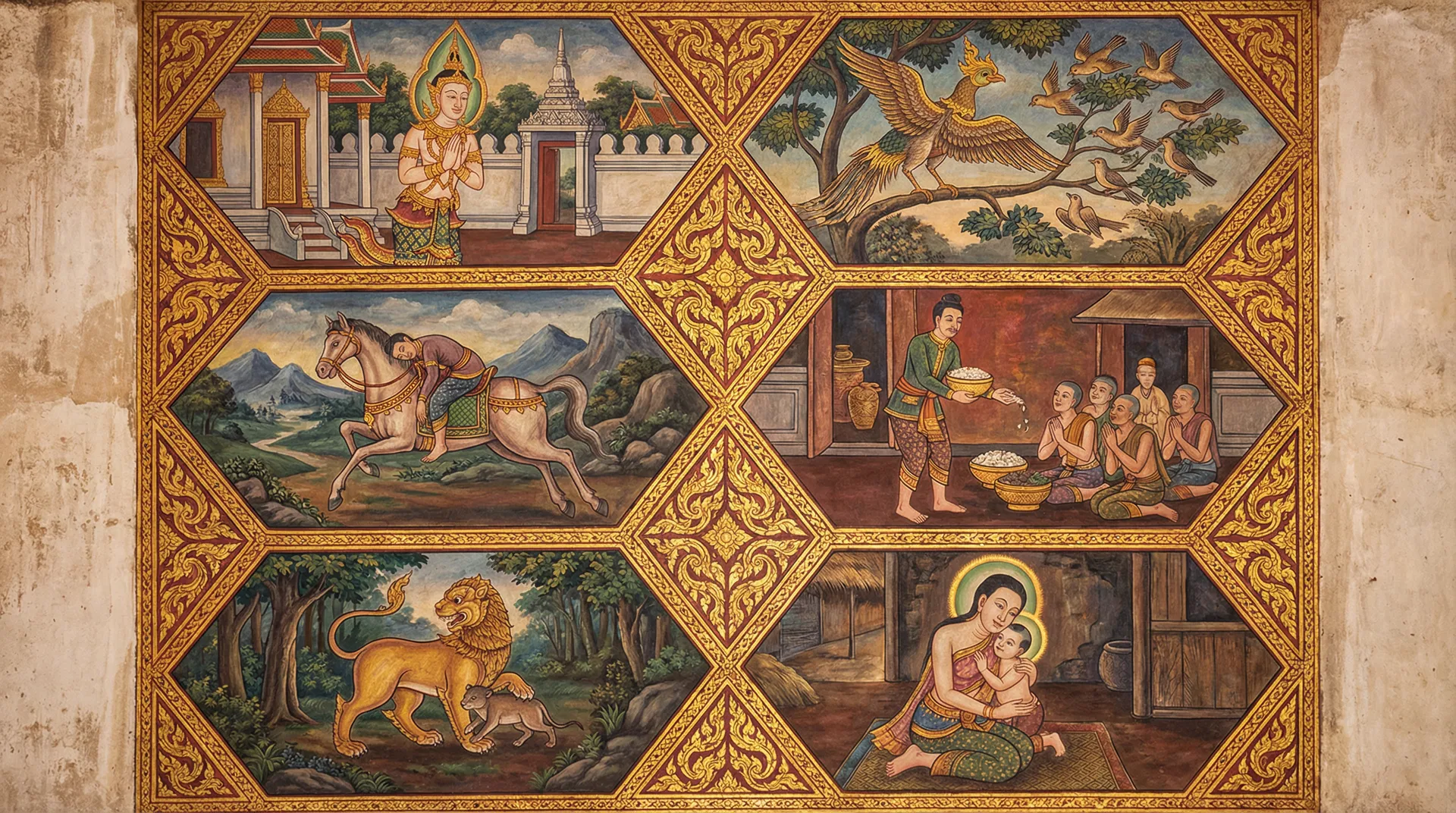
One day, a group of villagers, hearing about the silent ascetic in the forest, came to offer him food. They brought him the finest fruits and grains. Bodhisattva, as was his practice, accepted what was offered with gratitude, eating only what was necessary to sustain his life, and sharing the rest with the birds and animals around him. King Janaka, watching this, realized that true generosity wasn't just about giving what one had in abundance, but about giving without expecting anything in return, even from oneself.
The King, having spent considerable time with Bodhisattva and witnessing his unwavering path, finally felt his own doubts begin to dissolve. He understood that the root of his own anxieties lay in the subtle ego, the desire for validation, even in his acts of kingship. Bodhisattva's silent example showed him that true virtue stemmed from a place of pure intention, free from any self-serving motive.
Finally, feeling that his lesson was complete, King Janaka approached Bodhisattva once more. This time, he bowed deeply. "Your silence has spoken louder than any words," he said, his voice filled with reverence. "You have shown me that true detachment and inner peace are not achieved through outward displays of austerity alone, but through the unwavering discipline of the mind and the purity of one's intentions. My doubts have vanished, and I see the path forward with clarity."
Bodhisattva, his vow of silence nearing its end, finally spoke. His voice was like the gentle rustling of leaves, calm and full of wisdom. "Great King," he said, "the greatest austerity is not the renunciation of the world, but the conquest of one's own mind. To act with a pure heart, without seeking praise or fearing blame, that is the path to true liberation. Your own journey has taught you much, for in seeking to understand my silence, you have found the answers within yourself."
King Janaka returned to his kingdom, his heart light and his mind clear. He ruled with renewed wisdom and compassion, his actions now guided by the profound understanding that true righteousness lies in selfless service, free from the subtle bonds of ego and desire. He had learned that even in the midst of worldly duties, one could cultivate an inner sanctuary of peace and purity, mirroring the serene strength of the silent ascetic in the forest.
— In-Article Ad —
💡Moral of the Story
True enlightenment and peace come from conquering one's own mind and acting with pure, selfless intentions, free from ego and the desire for recognition.
Perfection: Patience (Khanti) and Wisdom (Panna)
— Ad Space (728x90) —
More Jataka Tales You May Enjoy
 228Dukanipāta
Umesavajja-jātaka
The Tale of the Flawed Gem In the bustling metropolis of Varanasi, a city renowned for its vibrant m...
💡 True perfection is not the absence of flaws, but the wisdom and humility to acknowledge, accept, and actively work towards overcoming one's shortcomings. Embracing learning and collaboration, rather than hidden pride, leads to greater wisdom and effectiveness.
 393Chakkanipāta
Kusa Jataka
Kusa JatakaIn the ancient kingdom of Mithila, ruled a benevolent king named Sudassana. His reign was...
💡 Patience, forgiveness, and righteous principles can overcome hatred and transform enemies into friends.
 38Ekanipāta
The Jataka of the Great King of the Utmost Wisdom
In the city of Savatthi, during the time of the Buddha, the Bodhisatta was born as the wise prince n...
💡 Unwavering adherence to truth and virtue possesses a divine power that can overcome deceit and injustice.
50EkanipātaThe Bodhisatta as the King of the Sarabha
The Bodhisatta as the King of the SarabhaIn the wild and untamed Himalayas, where snow-capped peaks ...
💡 True courage lies in selfless sacrifice for the protection of others, demonstrating profound compassion.
100EkanipātaThe Tale of Timpinnaka
In a time long past, when the Bodhisattva was yet a divine being, in this very existence he was rebo...
💡 True prosperity comes from a pure heart and selfless actions. Greed leads to destruction, while compassion and generosity create lasting blessings.
55EkanipātaThe Bodhisatta as the Young Brahmin
The Bodhisatta as the Young BrahminIn the ancient city of Ujjain, a place of profound spiritual lear...
💡 Selfless service and pure compassion, born from a heart devoted to alleviating suffering, can overcome even the greatest adversities and reveal the divine within.
— Multiplex Ad —